 RECORD
Send it today. It arrives tomorrow.
Seal a message to Voyager 1’s distance. Cryptography keeps it locked until its light gets there, about a day from now, then it opens on Solana for everyone.
Light time from Earth to Voyager 1, now
try: · ·
Sealing in your browser…
- Distance from Earth
- 0 km
- In flight
- 0 s
- Left Earth
- just now
- Next
- —
- Reaches Voyager 1’s distance
- —
Call it now. Prove it tomorrow.
Seal a price call, a prediction, a time capsule or a letter. Your browser encrypts it to a drand round that only exists once its light has reached Voyager 1’s distance. Until then nobody can read it, not us and not you. Then anyone can: it opens here, on its own page, next to the signed original, so the receipts are permanent.
runs on this sitelive public datareal data, bundledat launch
Latest seals demo data
Every seal, newest first. Sealed ones show only their ciphertext and a countdown; they open about a day after they were sent.
Your record is your record.
Seal as many as you like. They all open, the misses too, and every seal stays on-chain next to its wallet. Nobody gets to show only their winners.
—
After a call opens, its author tags it “called it” or “missed” with a signature; other wallets can disagree once each. A “called it” with 3 or more disagreements, more than agreements, counts as a miss. Untagged calls count as missed after 7 days.
Cut your own record.
Type a line and the lathe cuts it. Each letter becomes eight bits and each bit a wiggle in the groove, etched by hand around the label too. Once sealed, the record shows only its ciphertext, so you can post your call now and prove it tomorrow.
Yours
The words, the dedication and the greeting. Change them as often as you like.
Nature’s
Set by the speed of light, JPL’s ephemeris and the dishes. You can’t change these.
Minting opens at launch, as a compressed NFT of your record once your pulse arrives. Nothing to sign yet.
Every pulse ends in a certificate.
When a pulse reaches Voyager 1’s distance, it gets a numbered page stamped with the exact distance it crossed and how long it took. These are the latest arrivals.
A golden record sets a distance record.
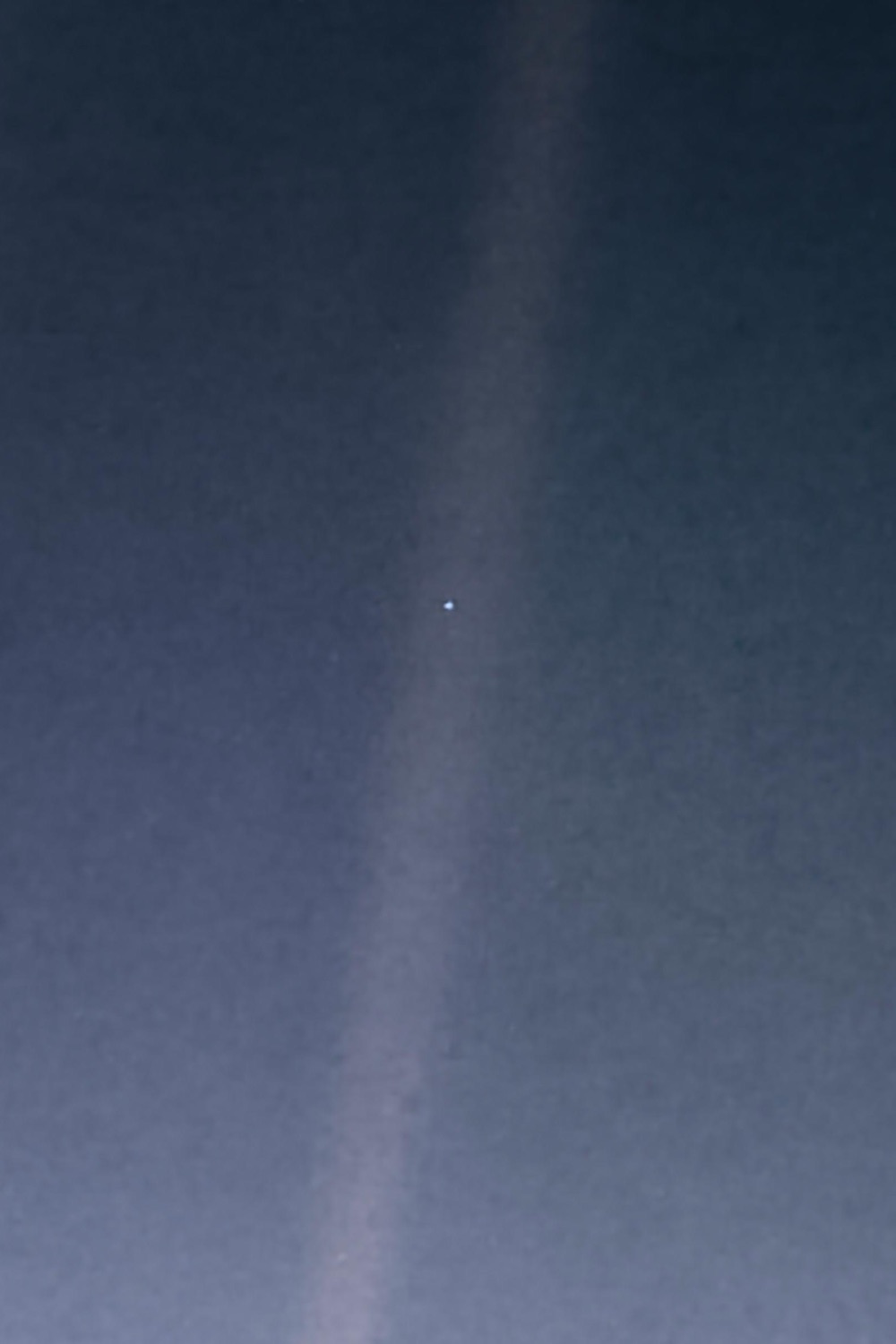
Voyager 1 left Earth on 5 September 1977 with a golden record, built for a five-year mission. It is still talking: about 160 bits per second, from beyond the edge of the Sun’s wind, caught by giant dishes in California, Spain and Australia.
On 18 November 2026 it will be one light-day from Earth, farther than anything we have built has ever gone. A hello sent that morning arrives the next morning.
Today there is still a small window: a pulse sent in the first 5 m 49 s after midnight UTC lands the same day. It shrinks every day. The last one opens at midnight on 17 November and lasts about 5 s. After that, everything arrives tomorrow.
RECORD turns that moment into a clock. Every message a holder sends starts a pulse at the speed of light. Watch it pass the Moon in about a second, Mars in minutes and Neptune in about four hours, then reach Voyager 1’s distance a day later. When it arrives, it gets a certificate stamped with the exact distance it crossed.
And there is no going back. JPL’s trajectory has Voyager 1 never returning inside a light-day: even in late April 2027, when Earth swings back toward it, light will need 24 h 01 m 29 s.
How long light takes from Earth today
We don’t transmit anything to Voyager 1. Only NASA’s Deep Space Network can. Each pulse is a clock running at the speed of light, timed against Voyager 1’s real distance.
Dates from NASA/JPL: the launch, the 2012 heliopause crossing, and instruments switched off to save power (the latest in April 2026); NASA aims to keep at least one instrument running into the 2030s. The 2026 and 2027 figures are computed from JPL Horizons.
Voyager 1, right now.
Distances are interpolated every frame from an hourly JPL Horizons ephemeris. Dish status comes from NASA’s DSN Now feed, checked every 10 seconds.
Checking the Deep Space Network…
- Distance from Earth
- —km
- —
- One-way light time
- —
- —
- Moving away from Earth
- —km/s
- Changes through the year as Earth orbits
- Speed relative to the Sun
- —km/s
- —
- Distance from the Sun
- —AU
- Crossed the heliopause at about 122 AU, Aug 2012
- Since launch
- —
- 5 Sep 1977, 12:56 UTC, Cape Canaveral
The ledger.
Every pulse is timed against JPL’s Voyager 1 ephemeris. Each row links to a page with the signed statement, the ciphertext and, once open, the drand beacon that opened it. Data as JSON: /api.